thanks for joining our pack!

The Real (and Slightly Chaotic) Process of Planning Our First Trip!
Michigan to Colorado (down Route 66)
H
2/1/20263 min read
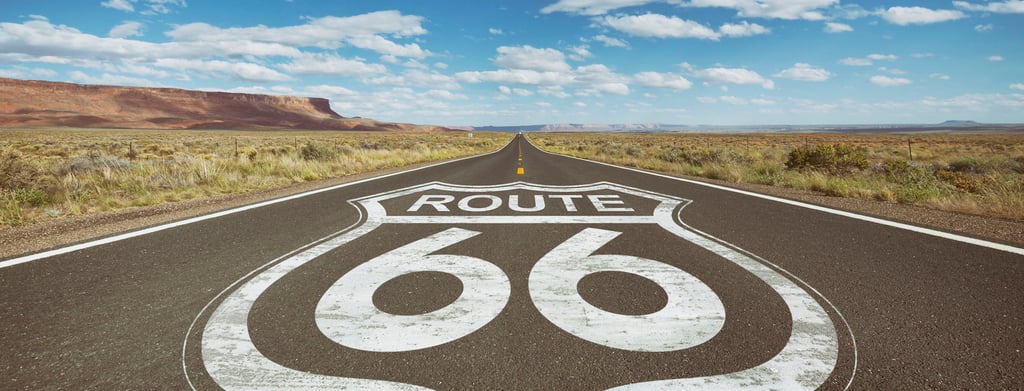
Hey everyone— I am currently knee-deep in spreadsheets, endless Chrome tabs, and a dog who's already sensing something exciting is coming. We are pulling our travel trailer from Lansing, Michigan, down (parts of) historic Route 66 to Joplin, Missouri, then continuing along the Mother Road through Oklahoma, Texas, and New Mexico all the way to Santa Fe, before finally heading north into Colorado. We're doing this as newbie boondockers with occasional paid RV sites only when we need to dump, fill, or recharge batteries (and ourselves). The planning has been equal parts fun and frustrating. Here's the honest breakdown of what we've obsessed over most: how far we can realistically drive each day with a trailer and a dog, how much we're actually spending on overnight stops, and why finding spots along Route 66 feels like a treasure hunt with way fewer treasures than you'd expect.
Daily Driving: Keeping It Sane with a Trailer
We started by googling our journey from Joliet, IL to Joplin, MO, knowing we didn't want to drive into Chicago with a trailer. We are splitting up our Route 66 journey into 2 parts, ending the first in Santa Fe, NM. We needed to be extra careful of finding places to stay and not driving too long in one day. This is a road trip after all, we will be stopping a lot!
Most RVers pulling trailers aim for 150–220 miles per day (that's roughly 3–6 hours of actual driving, not counting stops). Anything over 250–300 miles starts feeling punishing—trailer sway on old alignments, narrow shoulders, stop-and-go traffic in towns, and the fact that Route 66 isn't all interstate means you're averaging closer to 40–50 mph than highway speeds.
We've settled on a loose rule: no more than 3 hours of driving per day on the twistier Route 66 legs (about 100 miles max), bumping up to 5 hours on the straighter stretches like parts of New Mexico or the drive north to Colorado via I-25. That leaves plenty of afternoons for exploring neon signs, classic diners, or just letting Margarita run around in a few unique parks. Slow travel is the whole point, right? After Joplin, the extended route adds roughly 700 miles to Santa Fe, which we're breaking into about 7-8 relaxed days. From there, heading north to Colorado Springs on I-25, with potential stops like Raton Pass or Pueblo for scenery and rest.
The Money Side: Boondocking vs. Paid Sites (and the Sticker Shock)
Budgeting for camping was eye-opening. Boondocking is free (or donation-based), but paid RV parks along Route 66 average $35–$65/night for full hookups—higher in popular spots, lower at state parks. Harvest Hosts or similar can be "free" with a purchase, but we can't count on them every night. We’ve been using FreeCampsites.net, and it’s been very helpful so far. We are also going on each location's website, whether that be an RV park or a State/National Park. There is always the Walmart, Cracker Barrel, or Bass Pro Shop option as back up for your back up! 😉
Paid spots are necessary for recharge days (dumping tanks, laundry, long showers). We decided on a few spots that are lower-cost than the RIDICULOUSLY priced Love’s Travel Stations. We are evenly spacing our “full-hook-up” nights throughout our trip so we can rest and reset accordingly.
The real lesson? Apps like Campendium and FreeCampsites.net are gold, but reviews from 2024–2025 are crucial—some "free" spots have gotten crowded or restricted. We cross-check everything and have backup plans.
Route 66 Reality Check: Not as Many Sites as You'd Think
We assumed Route 66 would be littered with RV parks in every quirky town. Nope. It's more like 1–4 solid options per major stop (if that), and state parks a short detour off the route. Way fewer. Towns like Gardner or Atlanta, IL have pull-offs or attraction lots that work for a night, but don't expect a full campground in every photo-op town. It's not glamorous, but it's authentic.
Planning this has been a crash course in patience—endless tabs, deleted itineraries, and learning that "flexible" means having three backup spots per night. But that's the magic: the trip isn't just the drive; it's the hunt for the perfect free overlook, the debate over one more paid shower, and the slow realization that 150 miles a day is plenty when there's a giant hot dog statue waiting.
If you're planning something similar, what's the one thing that surprised you most in your research? Drop it below—I'm still tweaking ours!
Safe (and slow) travels,
xoxo
H, D, M🐕
Contact
fur.mula4love@gmail.com
© 2025. All rights reserved.


Fur-mula For Love LLC